Become an Installer



“I heard polyaspartic cures in the bucket before you can even roll it out.”
If you’ve been in the flooring world for any amount of time, you’ve heard some version of that. It’s one of the biggest reasons experienced epoxy installers hesitate before switching to faster-curing systems. If you’ve ever burned a batch of two-component epoxy because someone got slow on a hot day, the idea of an even faster product sounds like a recipe for disaster.
But here’s the thing — working time of fast cure floor coatings like polyaspartic is usually misunderstood. The real issue isn’t the chemistry. It’s the technique. Once you understand it, the whole anxiety around fast-curing topcoats basically disappears.
Pot Life Is Not the Same as Working Time
This is where most people get confused, and it’s worth slowing down on.
Pot life is how long a mixed product stays workable while it’s still sitting in the bucket. In a container, the two components are in close contact, the mass is concentrated, and heat builds up fast. That’s called a mass-exothermic reaction. The more material you have packed together in one place, the faster the heat builds, and the faster the product cures. For polyaspartic systems, this can mean pot life of 15–25 minutes depending on ambient temperature.
Working time is how long the material stays open and workable once it’s spread out on the floor. This is an entirely different number — and it’s a lot more favorable.
When you pour a fast-cure coating out onto concrete and spread it thin, the exothermic reaction slows way down. The heat has nowhere to build up. That mass-exothermic process basically stops. A product that might gel in 20 minutes inside a bucket can stay workable for 40–50 minutes once it’s spread at the right thickness on the slab.
That’s the gap most epoxy installers don’t know about when they’re new to polyaspartic. And it’s exactly why technique matters so much.
The Technique: What It Is and How to Do It Right
The technique is the single most important thing to learn when you’re working with fast-cure floor coatings. It’s not complicated, but it has to become a habit.
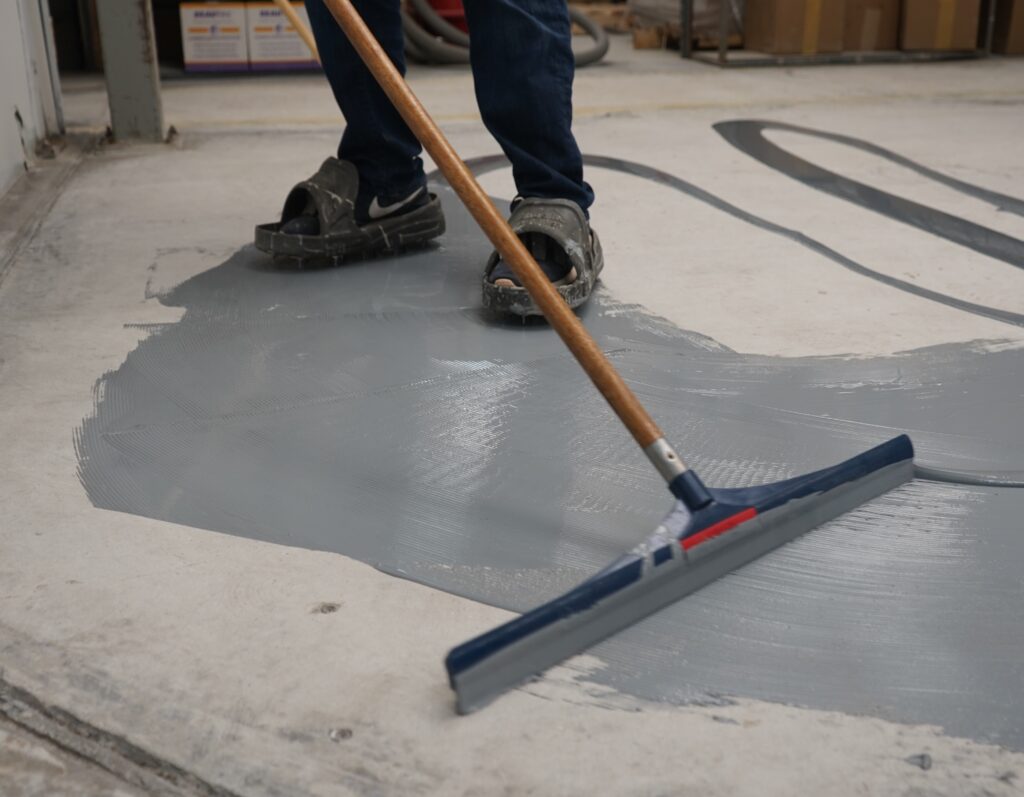
Instead of mixing a full batch and then figuring out where to start, you pour the mixed product out onto the floor in a thin ribbon or serpentine line — immediately after mixing. Don’t let it sit. Don’t answer the phone. Pour it out.
Here’s how it works step by step:
Mix the two components fully. Proper mixing matters. Under-mixed product will have soft spots and inconsistent cure. Follow the manufacturer’s mix ratio exactly — with Optus polyaspartic systems, that information is on the technical data sheet.
Pour immediately in a ribbon pattern. Move in a consistent back-and-forth motion as you pour, laying down a thin, even line of material across the floor. You’re spreading the product out before the exothermic reaction has a chance to build up. Think of it like cooling the material as you go.
Backroll right behind the pour. One person pours the ribbon, another follows immediately with a roller or squeegee to spread and level. The key is keeping the material thin and moving. Thick puddles = heat buildup = shortened working time.
Work in manageable sections. Don’t try to mix a 3-gallon kit for a small crew on a warm day. Mix smaller batches more frequently. This keeps you in control of the working time window.
When everything is done right, you get the full benefit of fast-cure floor coatings — quicker return-to-service, same-day topcoat, reduced job time — without the panic of racing a bucket.
How Temperature Affects the Equation
Temperature is the other variable that trips people up when they’re learning how to extend polyaspartic pot life on the jobsite.
Hot ambient temps = faster cure. Cold temps = slower cure. This isn’t unique to polyaspartic — every two-component resin system behaves this way — but the effect is more noticeable with fast-cure products because the baseline cure speed is already elevated.
On a 90-degree day, your working window is tighter. On a 55-degree morning, you’ve got more time. Experienced polyaspartic applicators adjust their batch size and pour speed based on what the thermometer says when they walk in the door. It becomes second nature pretty quickly.
Some general rules that help:
- Mix smaller batches on warm days
- Store product in a cool area before mixing — not in a hot truck bed
- Avoid applying in direct sunlight when possible
- Monitor substrate temp, not just air temp (concrete in the sun can be 20 degrees hotter than the air)
Optus Resin can help you calculate batch sizes and timing for specific ambient conditions if you’re new to fast-cure systems. It’s one of those calls worth making before your first big polyaspartic job.

Why Experienced Installers Actually Prefer It
Once the pouring technique clicks, most applicators don’t want to go back to slow-cure epoxy for topcoats. The speed of polyaspartic systems is a genuine competitive advantage — not a liability.
You can apply a base coat, broadcast flake or quartz, and topcoat in a single day on most commercial jobs. That’s a huge deal for customers who can’t afford extended downtime. It’s also a selling point that separates you from crews still using 24-hour-cure epoxies.
Optus offers polyaspartic systems as part of their flooring product line — including OptiFlake and OptiQuartz applications where a fast-cure clear top is standard. Their training covers the ribboning technique hands on, so you’re not figuring it out on a live job.
The anxiety around fast-curing products is real. But it’s based on using the wrong technique, not on a flaw in the chemistry. Get the pour right, and polyaspartic becomes one of the easiest tools in your kit.